
Broadway Brewery
San Francisco, CA
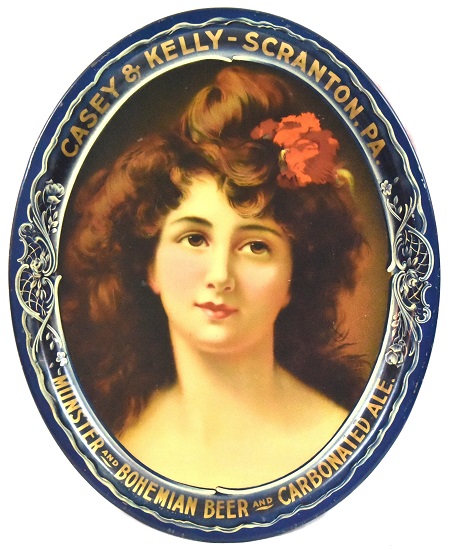
Casey & Kelly Brewing Co.
Scranton, PA

Cold Spring Brewing Co.
Lawrence, MA

Cold Spring Brewery
Sunbury, PA

Frankenmuth Brewing Co.
Frankenmuth, MI

Freeland Brewing Co.
Freeland, PA

M.K. Goetz Brewing Co.
St. Joseph, MO
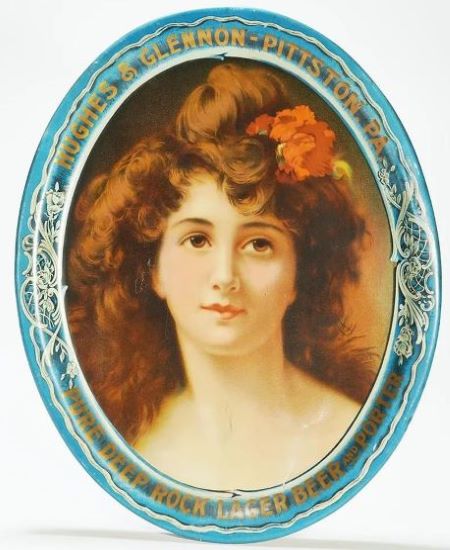
Hughes & Glennon
Pittston, PA

Peter Kranz
Carbondale, PA

Lackawana Brewing Co.
Scranton, PA
.jpg "Pennsylvania Central Brewing Co. of Scranton")
Pennsylvania Central Brewing Co. of Scranton
Scranton, PA

Reichard & Weaver Brewing Co.
Wilkes Barre, PA

E. Robinson's Sons
Scranton, PA

West Point Bottling Works
West Point, NE
The 'Stock' Exchange
H.D. Beach Co. No. 3-B - Rosalind or Rose Girl
H.D. Beach Co. No. 3-B - Rosalind or Rose Girl
Date: 1902 - 1905
Size: 13.5" x 16.5"
Type: Inverted Pie
Scarcity: Common
Value: $$$ to $$$$$$
Condition & Brewer Dependent
Size: 13.5" x 16.5"
Type: Inverted Pie
Scarcity: Common
Value: $$$ to $$$$$$
Condition & Brewer Dependent

Stock
--

Elzear Fortier Ginger Ale Soda
Montreal, Quebec, Canada

Golden Cross Pure Rye
Unknown

Hinkle & Woods Hardware
Bringhurst, IN

Metropolitan Saloon- Wine Liquors & Cigars
Unkown

Carl Nollenberger Wine, Liquor & Cigars
Leadville, CO

Wertheimer-Swarts Shoe Co.
St. Louis, MO
Click the Picture to Return to Meek & Beach Stock Catalog Page
Comments:
The number '3' appears on a number of different versions of this fairly common tray. Occasionally they are marked 'H.D. Beach.' Beach never dated their trays, nor titled them like Meek, though American Art Works did later.
In this case, the featured image is the work of Angelo Asti, a late 19th century French painter of Italian heritage, famous for painting beautiful women. He worked for a Cincinnati Lithography Company for several years in the 1880's. This image is cataloged as "Rosalind" and was apparently licensed by Beach (as well as others; you may encounter it on postcards or porcelain among other products). Beach may have adopted the licensing approach and then Meek copied the practice later (there are numerous references in early 20th century Coshocton newspapers about Meek being abroad in Europe buying artwork to reproduce at Meek & Beach/Meek Co).
In tray form, the early versions were always oval, although a few examples of tin-over-cardboard and self-framed-tins (SFT) are known. This tray appears with 2 different rims—the more common faux serving tray version and the solid blue rim with fancy scrolling. Advertising text on the former tends to be printed on the image itself; on the latter it usually appears on the rim.
To add confusion to the story, Kaufmann & Strauss also issued a Rosalind tray in a 13" plate form. The perspective is from a further distance and a bit of her gold dress can be seen (which appears in Asti’s original).
The number '3' appears on a number of different versions of this fairly common tray. Occasionally they are marked 'H.D. Beach.' Beach never dated their trays, nor titled them like Meek, though American Art Works did later.
In this case, the featured image is the work of Angelo Asti, a late 19th century French painter of Italian heritage, famous for painting beautiful women. He worked for a Cincinnati Lithography Company for several years in the 1880's. This image is cataloged as "Rosalind" and was apparently licensed by Beach (as well as others; you may encounter it on postcards or porcelain among other products). Beach may have adopted the licensing approach and then Meek copied the practice later (there are numerous references in early 20th century Coshocton newspapers about Meek being abroad in Europe buying artwork to reproduce at Meek & Beach/Meek Co).
In tray form, the early versions were always oval, although a few examples of tin-over-cardboard and self-framed-tins (SFT) are known. This tray appears with 2 different rims—the more common faux serving tray version and the solid blue rim with fancy scrolling. Advertising text on the former tends to be printed on the image itself; on the latter it usually appears on the rim.
To add confusion to the story, Kaufmann & Strauss also issued a Rosalind tray in a 13" plate form. The perspective is from a further distance and a bit of her gold dress can be seen (which appears in Asti’s original).
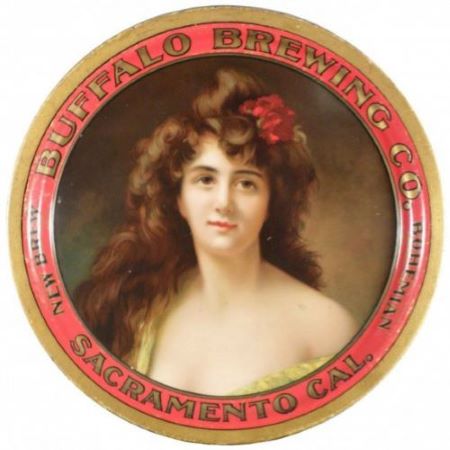
H.D. Beach
Version
Version
Kaufmann & Strauss
Version
Version


Confirmed Brewer used Stock Trays
Non-Beer Related & Non-Tray Uses


